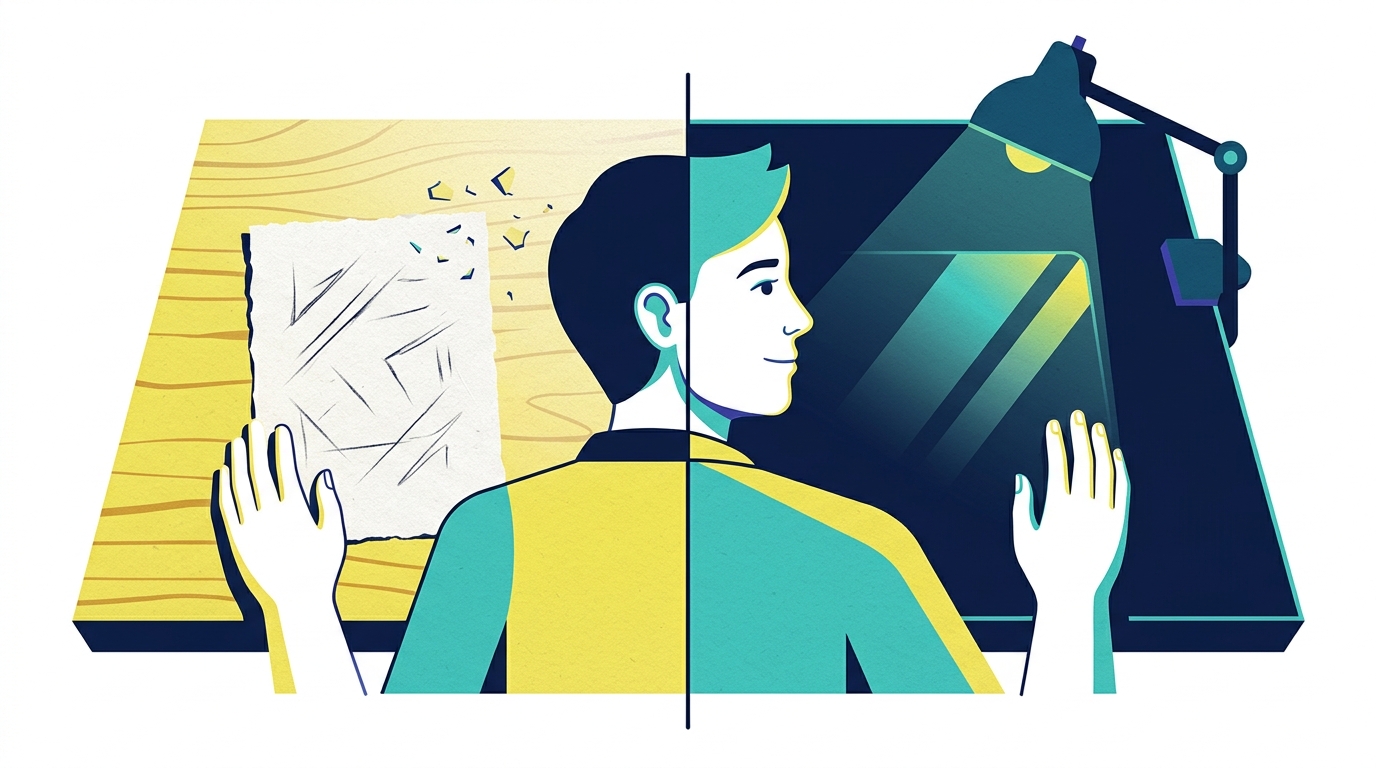
Online tutoring provides immediate access to niche syllabus specialists and examiners regardless of location, whereas in-person tutoring delivers physical pacing, immediate non-verbal accountability, and sensory grounding. Rather than selecting a format based on commute convenience or timetable ease, parents should evaluate where their child experiences cognitive friction. Self-directed pupils preparing for advanced secondary assessments benefit most from remote subject specialists, while students struggling with task initiation, sensory regulation, or attention avoidance require an educator physically in the room.
The real trade-off: specialist access versus somatic focus
Most parents frame the debate between remote and face-to-face tuition around logistics. Remote lessons eliminate suburban traffic jams and slot neatly between extracurricular commitments; home visits save parents from acting as transport dispatchers. This logistical lens routinely produces poor learning outcomes because it ignores how different brains process instruction across a screen.
Online tuition thrives when the primary bottleneck is academic expertise. If a student is taking International Baccalaureate (IB) Higher Level Physics or sitting OCR A-Level Further Mathematics, the local geographic pool of qualified tutors is often thin. A remote lesson unlocks career educators and senior examiners who understand mark-scheme idiosyncrasies down to the specific command words. For an academically resilient pupil who takes independent notes and asks precise questions, the digital format moves faster: digital whiteboards allow instant diagram manipulation, past-paper annotation, and cloud-stored session records.
In-person tuition, by contrast, resolves behavioral and executive friction. When a student sits next to an experienced tutor, the interaction relies on somatic focus. The tutor notices minute physical cues that a web camera misses: the tightening of a jaw before asking a question, a pencil hovering indecisively over a geometry proof, or subtle breathing changes that signal working memory overload. For an anxious teenager or a student with attention deficits, physical presence establishes a social contract that keeps them tethered to the page.
The Cognitive Friction Diagnostic: a three-session trial
To determine which environment serves your child, run a three-session diagnostic trial rather than committing to a term-long contract. During these trial lessons, monitor three operational metrics:
- Screen endurance threshold: Does the student maintain authentic cognitive processing past minute 35, or do their eyes glaze over into passive media consumption?
- Tactile intervention requirement: Does the subject require physical manipulation of apparatus, compass work, structured handwriting adjustments, or spatial layout that is clumsy over an auxiliary desk camera?
- Real-time redirection count: How many verbal prompts does the tutor issue per hour to bring the student back to the task?
Apply this decision rule: if a tutor spends more than 15 percent of an online lesson troubleshooting camera angles for written work or pulling a student back from secondary monitors and off-screen tabs, the geographic convenience of online delivery is entirely canceled out by the retention penalty.
In that scenario, an hour-long online lesson delivers less than 40 minutes of actual cognitive engagement. Paying for specialist digital access becomes counterproductive when half the lesson's working capacity is consumed by executive regulation.
Two worked scenarios: IB Chemistry versus GCSE Foundation Maths
To see how this framework functions in practice, consider two common European and UK-adjacent tutoring dilemmas.
Example A: Year 12 IB Diploma Chemistry in Brussels
A student attending an international school in Brussels is tackling IB Higher Level Chemistry. Her motivation is high, but her target university conditional offer requires a 7 in Chemistry. The local supply of native-English IB Chemistry tutors charging within typical European ranges (€70–€90 per hour) is limited. Her executive function is sound: she maintains a tidy physical binder, uses a dual-monitor desktop setup cleanly, and proactively flags sub-topics where she loses marks on stoichiometry calculations.
The decision: Digital delivery is optimal. The family selects an experienced IB examiner based in northern England. The student uses a graphics tablet alongside the tutor's shared workspace. Because there is virtually zero behavioral friction, 100 percent of the hourly fee directly targets mark-scheme parsing and conceptual refinement.
Example B: Year 10 GCSE Foundation Maths in Kent
A 15-year-old student preparing for Edexcel GCSE Foundation Mathematics in Kent faces significant academic avoidance. When confronted with multistep word problems, he freezes, hides his working behind his hand, and opens background browser windows during school lessons. His parents initially considered online lessons at £45 per hour to avoid driving during the weekday evening peak.
The decision: In-person tuition is essential, even if it commands a slightly higher rate (around £55 per hour) or requires adjusting the family dinner routine. The student does not need a hyper-specialized examiner; he needs an educator sitting at the same kitchen table who can gently reposition his lined notebook, physically demonstrate working layout, and catch the moment avoidance begins before it curdles into anxiety.
Format selection checklist: audit your child's executive baseline
Before booking a tutor, evaluate these student baselines:
- Physical task visibility: Can the student display their workings without complex hardware setups? If the subject is essay-based (such as A-Level History or English Literature), typed shared documents work seamlessly online. If it requires hand-drawn graph plots or organic chemistry reaction mechanisms, in-person is safer unless they are already fluent with a graphics tablet.
- Secondary-screen discipline: Can the student keep their attention on one window without opening split-screen distractions, messaging apps, or gaming clients during instruction?
- Emotional tolerance for silence: When an online tutor pauses to let the student think, does the student experience the dead air as collaborative problem-solving, or do they feel isolated and freeze?
- Feedback reception: Does the student take cues better from shared digital annotation, or do they need a tutor to physically annotate alongside them to prevent defensive body language?
- Fatigue patterns at 17:00: After an entire school day of digital boards and institutional noise, does an additional hour of screen illumination produce sensory overload?
When coordinators review lesson performance across modern tutoring operations—such as within Tutlio—the data consistently shows that missed targets rarely stem from a tutor's lack of knowledge. They stem from a delivery format misaligned with the pupil's nervous system.
Frequently Asked Questions
Can we combine online and in-person tutoring across different subjects?
Yes. In fact, a split format often produces the best results. A student who struggles with organization in GCSE Sciences can benefit immensely from an in-person tutor who reviews their physical exercise books and folder systems weekly. That same student may successfully work with a remote tutor for modern languages, where oral fluency drills, audio playback, and digital flashcard sharing function exceptionally well over video calls.
What if an in-person tutor is not available for a rare syllabus?
If you are studying an uncommon subject—such as Pre-U legacy components, specific regional exam boards, or niche entrance assessments—and your child shows high distractibility, you must adapt the remote environment. Place the screen in a shared family space rather than a closed bedroom, use an external desk camera pointed down at their paper, and remove secondary input devices entirely to preserve focus.
Does online tutoring reduce academic anxiety compared to face-to-face sessions?
It depends on the source of the anxiety. For students with social anxiety who find an adult sitting next to them in their home intrusive or confrontational, the digital buffer offers control and reduces pressure. However, for students who experience perfectionistic paralysis when staring at a blank page, online lessons heighten anxiety because the tutor cannot intercede with quiet reassurance before panic takes hold.
About Tutlio
Tutlio is tutoring management software for private tutors and tutoring schools - lesson scheduling, student waitlist, Stripe payments, and automated reminders in one place. See pricing · browse more articles